Imagine a boxer coiled in the ring, eyes locked on an opponent. Within the span of a single heartbeat, they must anticipate a jab that might arrive in a few hundred milliseconds or a hook that develops over a full second. This isn’t just physical prowess; it is a feat of temporal prediction. Our lives are a constant dance with the future, requiring us to react to environments that shift at wildly different speeds. Whether we are a video game player responding to a digital ambush or a driver anticipating a changing traffic light, our brains are perpetually calculating the “when.” New research from a collaborative team of neuroscientists has finally pulled back the curtain on how the mind manages this feat, revealing a sophisticated internal system that prepares us for what comes next by constantly gauging the probability of the near future.
The researchers, hailing from institutions including the Ernst Strüngmann Institute and New York University, set out to discover how we stay so flexible in a world where timing is never static. They found that the brain does not simply wait for things to happen; it actively estimates how likely an event is to occur within a specific window of approximately three seconds. This isn’t a rigid countdown, but a fluid, living calculation. By understanding the likelihood of an upcoming flash of light or a sudden tone, the brain pre-activates its systems, ensuring that our reactions are both fast and accurate. It is this constant state of readiness that allows us to move through the world not as passive observers, but as active participants who are always one step ahead of the present moment.
A Single Language for Every Second
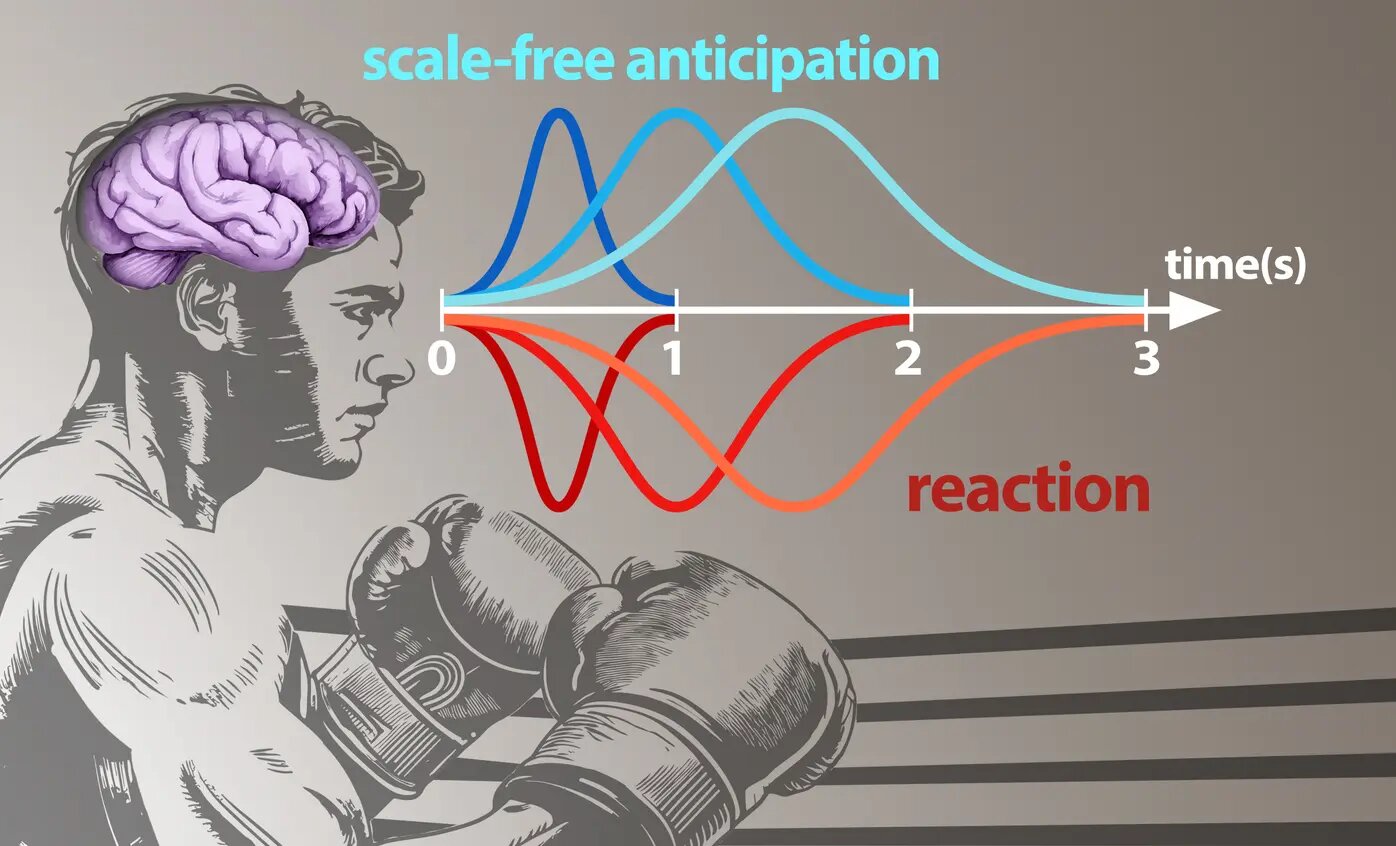
One might assume that the brain uses different mechanisms for ultra-fast reactions versus those that take a bit longer, but the study revealed a surprising unity in our mental clockwork. Through a series of psychophysical experiments, the team measured how quickly participants responded to simple visual and acoustic signals. By meticulously controlling the timing of these flashes and tones, they uncovered a principle that simplifies our understanding of the mind: the brain uses the same basic probability calculation regardless of the time scale. Whether an event is expected to happen in a fleeting few hundred milliseconds or over a span of several seconds, the underlying math remains identical.
This discovery points to a scale-free way of predicting the future. The brain doesn’t need a different “software” to handle a fast-paced sport versus a slow-moving task. Up to a range of at least three seconds, the mechanism for anticipation is consistent. This universal approach is exactly what allows for such seamless adaptation. If you move from a fast-paced environment to a slower one, your brain doesn’t have to relearn how to tell time; it simply applies the same probabilistic logic to the new rhythm. This efficiency is the secret behind why humans are so adept at switching between vastly different tasks without losing their stride.
When Certainty Sharpens the Internal Clock
While the method of calculation stays the same, the focus of our internal lens changes based on how sure we are about what is coming. The researchers found that probability actually sharpens our very sense of time. When the brain determines that an event is highly likely to occur at a specific moment, its tracking of time becomes incredibly precise. It is as if the internal metronome clicks louder and more clearly when we know the beat is about to drop. Conversely, when an event is less likely or its timing is uncertain, our internal timing becomes fuzzier and less precise.
This specific finding is a bit of a bombshell in the world of science because it directly challenges a long-standing concept known as Weber’s law. For years, this classic explanatory approach in psychology and neuroscience suggested that the precision of our timing shouldn’t be influenced by how likely an event is to happen. However, this new data shows that our brains are much more dynamic than Weber’s law would suggest. Instead of a fixed level of precision, our timing fluctuates based on our expectations. Probability doesn’t just tell us what might happen; it physically tunes our brain to perceive the passage of time with greater or lesser clarity.
The Architecture of Anticipation
To uncover these “laws of the mind,” the scientists had to look closely at how simple inputs—like a tone or a flash—translate into human action. The experiments showed that the brain is essentially a prediction machine that never sleeps. It is constantly looking ahead, second by second, to prepare for the “near future.” This preparation is what allows for the fast and accurate reactions that we often take for granted. By identifying these two key principles—the scale-free nature of probability and the sharpening of time through likelihood—the study provides a new blueprint for how human behavior is structured.
As Matthias Grabenhorst, the lead author of the study, points out, this explains the ease with which we navigate new environments. We aren’t just memorizing patterns; we are applying a universal timing strategy. This research moves us away from seeing the brain as a simple stopwatch and toward seeing it as a sophisticated statistical engine. It explains how we can anticipate an opponent’s move in a ring even when their timing is different from anyone we’ve fought before. We aren’t just reacting to the past; we are calculating a future that hasn’t happened yet, using the rhythm of probability to guide our way.
Why This Mastery of Time Matters
Understanding the mechanics of how the brain predicts the future is about much more than just explaining how we play sports or games. It strikes at the heart of the most fundamental human functions, including attention and decision-making. Every choice we make is rooted in a prediction of what will happen next, and if our internal clock is skewed, our ability to interact with the world begins to crumble. This research provides a vital foundation for understanding disorders that specifically impair a person’s sense of timing and prediction, offering a new lens through which to view cognitive challenges.
By revealing that the brain continuously prepares for the next three seconds, this study highlights the invisible work our minds perform every moment of our lives. It sheds light on the biological basis of our adaptability, showing that our survival and success depend on a constant, mathematical dialogue with the future. Whether we are avoiding a collision on the road or catching a falling glass, we are relying on this scale-free probability to keep us grounded in time. This research fundamentally changes our understanding of the human experience, proving that our ability to live in the “now” is entirely dependent on our brain’s remarkable ability to calculate the “next.”
Study Details
Matthias Grabenhorst et al, The anticipation of imminent events is time-scale invariant, Proceedings of the National Academy of Sciences (2026). DOI: 10.1073/pnas.2518982123